
Redwood County Property Tax Records
Redwood County property tax records are managed by the auditor-treasurer and assessor offices in Redwood Falls, Minnesota. Property owners can search parcel data, look up assessed values, check tax statements, and make payments online or in person at the courthouse. This page explains how the Redwood County property tax system works, where to find your records, how assessments are set, and what steps to take if you think your property has been overvalued.
Redwood County Overview
How Redwood County Property Taxes Work
Redwood County sits in southwest Minnesota and is largely agricultural. The county assessor values all real property as of January 2 each year under Minnesota Statutes Chapter 273. Farmland, rural homesteads, and small commercial properties make up most of the county's tax base. The assessor must value each parcel at its full market value, though classifications like agricultural homestead and timberland carry lower class rates that reduce taxable value.
The auditor-treasurer handles billing and collection for Redwood County property taxes. Tax statements go out by March 31. Payments split into two halves: the first half is due May 15, and the second half is due October 15. If you miss a due date, interest begins to accrue under Chapter 279. Properties with extended unpaid balances can eventually be forfeited to the state under Chapter 282.
The fall levy-setting process in Redwood County follows the Truth in Taxation requirements of Chapter 275. The county, townships, school districts, and other taxing districts each hold public hearings and set their levies before December 31. Combined, those levies determine the overall tax rate applied to your assessed value.
Search Redwood County Property Tax Records Online
The Beacon system by Schneider Geospatial is the main online tool for searching Redwood County property tax records. Beacon lets you search parcels by owner name, address, or parcel ID. You can view assessed values, ownership history, tax amounts, and GIS parcel maps. Access the Redwood County Beacon portal at beacon.schneidercorp.com. It is free to use and requires no account.
The county's official website at co.redwood.mn.us is also the starting point for county records. From there you can reach the auditor-treasurer at co.redwood.mn.us/departments/auditor-treasurer/, the assessor at co.redwood.mn.us/departments/assessor/, and the recorder at co.redwood.mn.us/departments/recorder/. Each department page has contact details and links to relevant forms and procedures.
The Minnesota Department of Revenue maintains interactive property tax data for all counties, including Redwood County. The screenshot below is from the DOR's property tax data portal at revenue.state.mn.us.
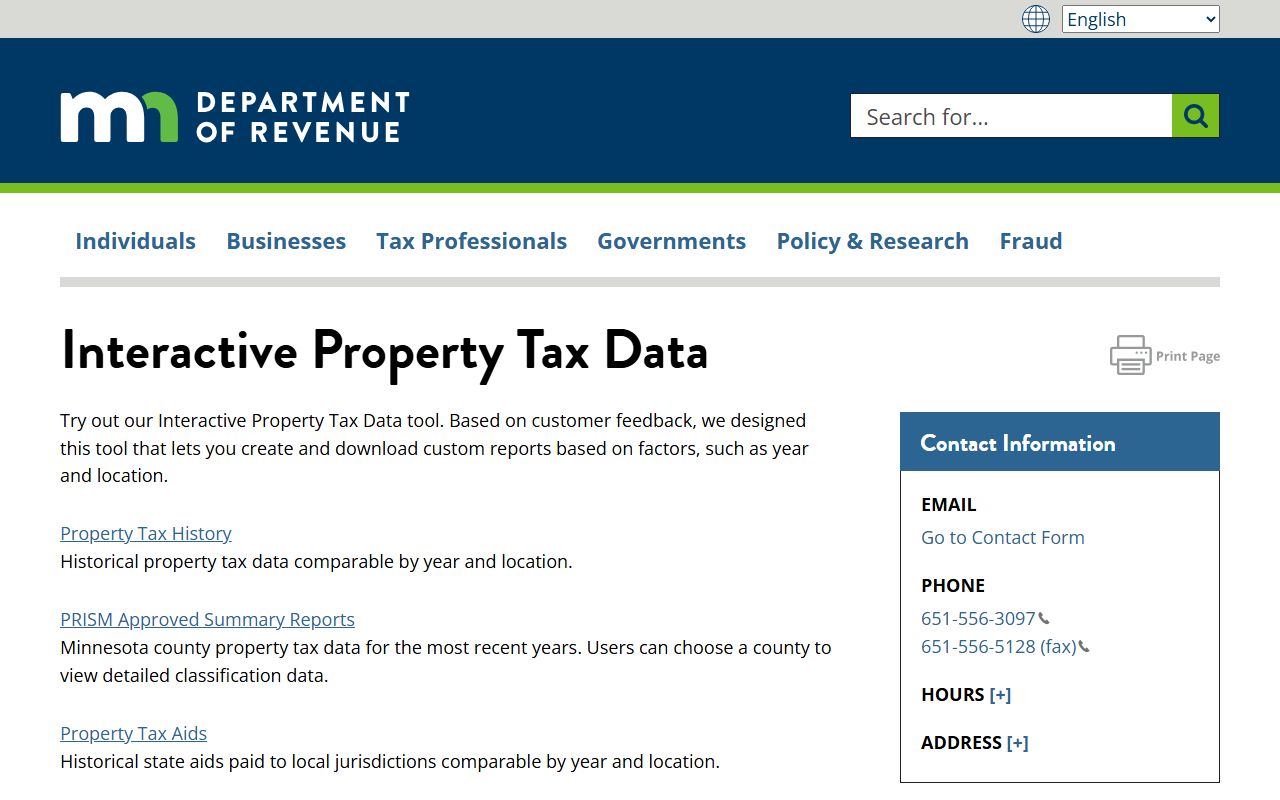
The DOR's interactive data tool at revenue.state.mn.us/interactive-property-tax-data lets you compare levy rates and assessed values for Redwood County and neighboring counties.
Redwood County Assessor Office
The Redwood County Assessor values all real and personal property in the county each year. This includes agricultural land, farmsteads, residential homes, commercial buildings, and vacant parcels. The assessor sets estimated market values as of January 2 and must apply the classification rules under Chapter 273. In an agricultural county like Redwood, proper classification of farmland and homestead parcels is especially important because it directly affects what you pay.
The assessor's office handles homestead applications, classification reviews, and questions about your assessed value. You can reach the office at (507) 637-4002 or through the assessor's page at co.redwood.mn.us/departments/assessor/. The office is at 250 South Jefferson Street in Redwood Falls. If you believe your value is wrong, the assessor is your first contact before any formal appeal.
| Office | Redwood County Assessor |
|---|---|
| Address | 250 S Jefferson Street, Redwood Falls, MN 56283 |
| Phone | (507) 637-4002 |
| Website | co.redwood.mn.us/departments/assessor/ |
Paying Redwood County Property Taxes
The Redwood County Auditor-Treasurer manages all property tax billing and collection. Your tax statement arrives by March 31 each year. The first half of annual taxes is due May 15. The second half is due October 15. Homestead properties with a total tax bill under $100 can be paid in full by May 15. Missing a due date starts interest accruing under Chapter 279.
Payments can be made in person at the auditor-treasurer's office at 250 South Jefferson Street in Redwood Falls. You can call the office at (507) 637-4013 with questions. For payment options including any available online or mail-in methods, check the department page at co.redwood.mn.us/departments/auditor-treasurer/. Keep your parcel ID from your tax statement handy. It is the fastest identifier when dealing with the office.
Note: If you have multiple parcels in Redwood County, each parcel has a separate tax statement and a separate due date calculation, so track them individually.
Homestead and Agricultural Classification
Homestead classification in Redwood County applies to a property you own and live in as your primary home. You must occupy the property by December 1 and apply by December 31 through the assessor's office. Homestead status carries a lower class rate than non-homestead residential property under Chapter 273, which reduces your total tax bill.
Redwood County also has a large share of agricultural homestead properties, where the landowner farms the land they live on or operates a qualifying farm. This classification can reduce the taxable value of both the house site and the agricultural land. Farmers who are unsure whether their property qualifies should contact the assessor at (507) 637-4002. Applying for the correct classification is worth doing before December 31.
The Minnesota Property Tax Refund through Form M1PR is available at the state level for qualifying homeowners and renters. Low and middle-income residents in Redwood County may qualify for a partial refund of property taxes paid. The form and instructions are available at revenue.state.mn.us.
Land Records and the Redwood County Recorder
The Redwood County Recorder's office handles deed recording and maintains the land records that support property tax assessments. When a property is sold or transferred, the deed is filed here and the deed tax is paid under Chapter 272. Sale data flows to the assessor's office, where it informs market value analysis for Redwood County parcels. This connection between sales and assessments keeps values grounded in real transactions.
You can search Redwood County land records and ownership history through the recorder's page at co.redwood.mn.us/departments/recorder/. The Beacon portal also pulls ownership and transfer data, so you can often find what you need without a separate trip to the courthouse. The Minnesota DOR's property tax statistics page at revenue.state.mn.us/property-tax-data-and-statistics publishes county-level data including Redwood County assessments and levies.
The screenshot below is from the DOR's property tax data and statistics page, which includes data for all 87 Minnesota counties including Redwood.
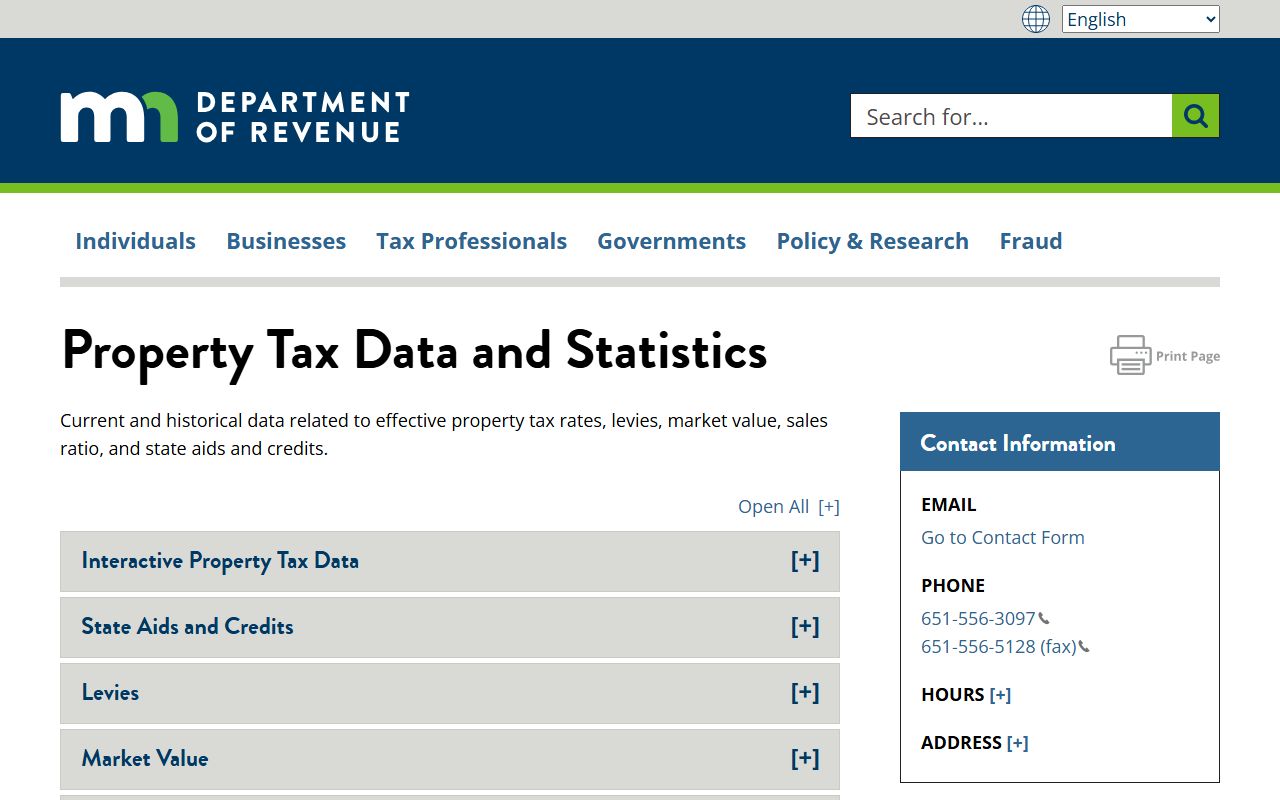
DOR statistics at revenue.state.mn.us/property-tax-data-and-statistics include levy summaries and assessment totals for Redwood County each year.
Appealing Your Redwood County Assessment
If you believe the assessor has overvalued your property, start by calling the Redwood County Assessor at (507) 637-4002. Many disputes resolve at this stage with a simple review. If you remain unsatisfied, you can appear before the Local Board of Appeal and Equalization in spring, which meets under Chapter 274. From there, you can escalate to the County Board of Appeal and Equalization.
If local options do not resolve the issue, you can file a petition with the Minnesota Tax Court. The deadline is April 30 of the year taxes are payable under Chapter 278. You can reach the Tax Court at (651) 539-3260 or through mn.gov/tax-court. Acting before the April 30 deadline is critical, as missing it typically closes the appeal window for that year.
Nearby Counties
These counties border Redwood County and each administers its own property tax records locally.