
Scott County Property Tax Records
Scott County property tax records are managed by the county assessor and auditor-treasurer in Shakopee, Minnesota. You can search parcel data, check assessed values, and look up tax payment history through the county's GIS system or by contacting the offices directly. This page covers how Scott County handles property tax records, where to find your tax statement, how the local assessment works, and what to do if you want to appeal your value or get help with a payment question.
Scott County Overview
How Scott County Property Taxes Work
Property taxes in Scott County follow the state framework that applies to all Minnesota counties. The county assessor sets a market value for each parcel as of January 2 each year under Minnesota Statutes Chapter 273. That value drives the tax you pay in the following year. Scott County has grown steadily over the past two decades and now has a mix of suburban residential areas, commercial corridors, and some remaining agricultural land near the county's western and southern edges.
The auditor-treasurer handles billing, collection, and distribution of tax revenue. Tax statements go out by March 31. Taxes split into two halves: the first half is due May 15 and the second half is due October 15. If your total tax is under $100 on a homestead property, you pay the full amount by May 15. Missing a due date starts interest accruing under MN Statutes Chapter 279.
Each fall, Scott County and the other taxing districts within its borders set their levy amounts through the Truth in Taxation process under Chapter 275. Local school districts, cities, townships, and special taxing districts each contribute to the total rate on your statement.
Note: Scott County is one of the faster-growing counties in Minnesota, which can affect assessed values year over year as new sales data enters the market.
Search Scott County Property Tax Records Online
Scott County maintains its own GIS property search system at gis.scottcountymn.gov. This is the primary tool for looking up Scott County property tax records online. You can search by owner name, address, or parcel identification number. The GIS system shows assessed values, land and building breakdowns, tax amounts, and ownership details. It is free to use and does not require an account. Scott County uses this system in place of the Beacon platform used by many other Minnesota counties.
The Scott County website at scottcountymn.gov provides links to the assessor, auditor-treasurer, and recorder departments. Each office has its own page with contact details, forms, and guides. The county's main offices are at 200 4th Avenue W in Shakopee. You can also reach the auditor-treasurer at (952) 496-8150 and the assessor at (952) 496-8976 for questions not answered online.
The Minnesota Department of Revenue publishes statewide property tax data and statistics at revenue.state.mn.us. This includes county-level levy data, assessed value totals, and historical trends. Scott County data appears in these statewide summaries each year.
The Minnesota DOR homepage is a central resource for property tax rules, forms, and guidance that apply to Scott County. The image below is from the DOR site where state property tax tools are housed.
The DOR site at revenue.state.mn.us provides property tax forms, refund information, and county-level data including Scott County.
Scott County Assessor Office
The Scott County Assessor values all real and personal property in the county each year. The assessor's office sets estimated market values for homes, commercial buildings, farms, and vacant land as of January 2. Under MN Statutes Chapter 273, all property must be valued at its fair market value unless it qualifies for a special classification. The Scott County Assessor page at scottcountymn.gov/departments/assessor covers the homestead application process, agricultural classifications, and how to request a review of your value.
If you think your assessed value is too high, start by calling the assessor's office. Many valuation questions get resolved quickly at that level. If not, you can attend the Local Board of Appeal and Equalization in the spring. This board meets under Chapter 274 and lets property owners present their case. Bringing recent comparable sales or an independent appraisal strengthens your argument. The next step after the local board is the County Board of Appeal and Equalization, then the Minnesota Tax Court.
| Office | Scott County Assessor |
|---|---|
| Address | 200 4th Avenue W, Shakopee, MN 55379 |
| Phone | (952) 496-8976 |
| Website | scottcountymn.gov/departments/assessor |
Paying Scott County Property Taxes
The Scott County Auditor-Treasurer handles property tax billing and collection. Tax statements are mailed to property owners by March 31 each year. The first half payment is due May 15. The second half is due October 15. If you miss a payment, interest begins under Chapter 279. Long-term delinquency can lead to tax forfeiture under Chapter 282.
You can pay Scott County property taxes in person at the auditor-treasurer's office at 200 4th Avenue W in Shakopee. The office phone is (952) 496-8150. The auditor-treasurer page at scottcountymn.gov/departments/auditor-treasurer lists current payment methods, including online and mail options. Keep your parcel ID from your tax statement ready when you contact the office. It makes the process faster.
The interactive property tax data tool from the Minnesota DOR lets you look at levy rates and assessed value trends across the state. The image below shows that tool, which covers Scott County data.
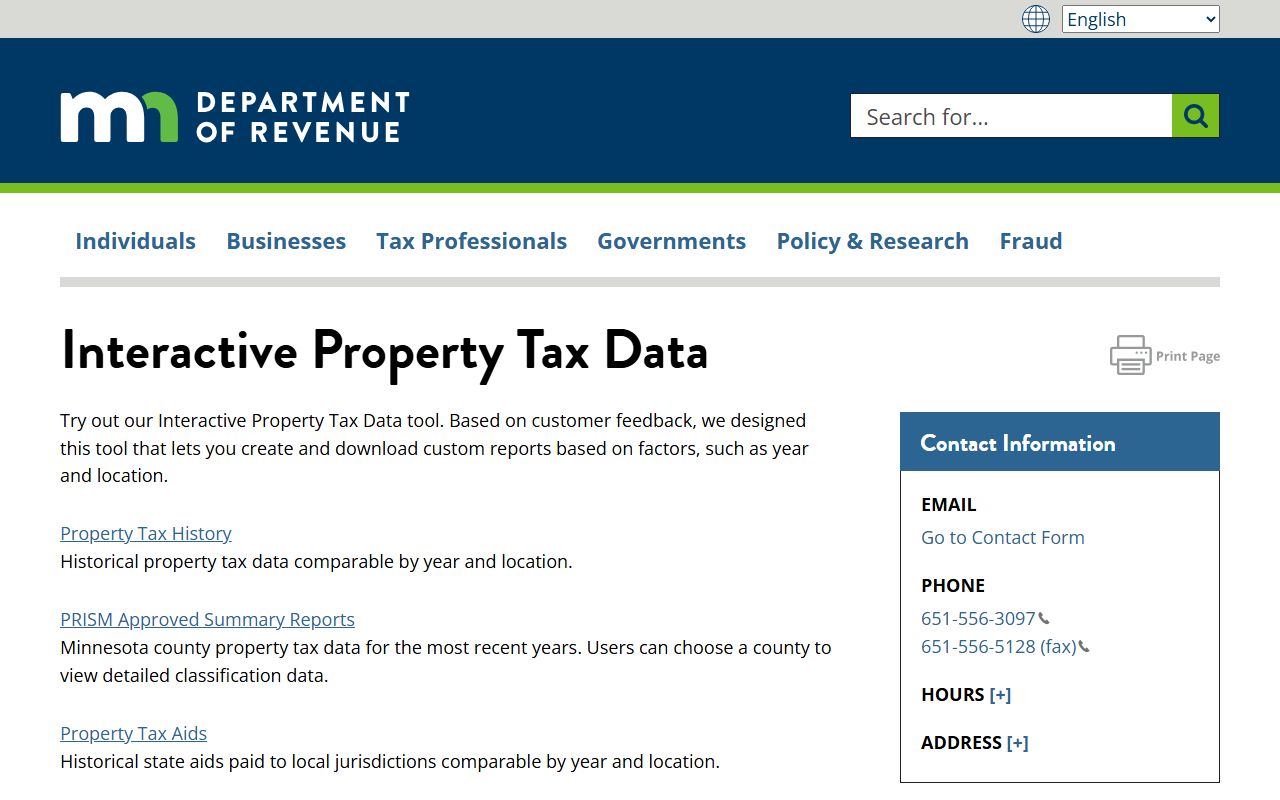
The interactive data tool at revenue.state.mn.us lets you compare levy rates, values, and trends for Scott County alongside other Minnesota counties.
Homestead and Property Tax Relief in Scott County
Homestead classification lowers the tax rate on your primary residence in Scott County. To qualify, you must own and live in the property as your main home by December 1 and apply by December 31 through the Scott County Assessor. You need to provide a Social Security number or Individual Taxpayer Identification Number. The homestead class rate is lower than the non-homestead rate, so getting this classification right matters. Under Chapter 273, homestead property benefits from a reduced class rate on a portion of its market value.
The Minnesota Property Tax Refund, filed using Form M1PR, is a state-level credit available to both homeowners and renters. The Minnesota Department of Revenue administers this program. If your property taxes are high relative to your household income, you may qualify for a refund. Details are at revenue.state.mn.us. This refund is separate from your county tax bill and comes from the state.
Note: Agricultural property in Scott County may qualify for the Green Acres program, which defers taxes based on agricultural use rather than development value.
Scott County Land Records and Recorder
The Scott County Recorder maintains deed and land records that connect directly to property tax assessments. When a property sells, the deed is filed here and the sale price informs the assessor's review of market values in the area. The deed tax paid at recording follows MN Statutes Chapter 272. The recorder page at scottcountymn.gov/departments/recorder provides information on how to record documents and search historical records.
Land records in Scott County include deeds, mortgages, easements, and other encumbrances going back many decades. Researchers, buyers, and title companies use these records to trace ownership history and check for liens. The county GIS system at gis.scottcountymn.gov pulls ownership data and parcel boundaries together in one searchable interface. It is a good starting point before contacting the recorder's office directly.
Appealing Your Scott County Property Tax Assessment
If you feel your Scott County property is over-assessed, you have a clear path to appeal. Start with the assessor's office. A phone call or visit often resolves basic valuation disagreements before they go further. If you are not satisfied, you can attend the Local Board of Appeal and Equalization, which meets each spring under Chapter 274. Bring evidence: comparable sales, photos, or an independent appraisal. The board reviews your case and can adjust the value.
The next level is the County Board of Appeal and Equalization. After that, you can file with the Minnesota Tax Court under Chapter 278. The Tax Court handles property tax appeals from all 87 Minnesota counties. You can reach them at (651) 539-3260. The filing deadline is April 30 of the year your taxes are payable. Missing that date means waiting another year, so act early if you plan to appeal.
Nearby Counties
These counties border Scott County. Each has its own assessor and auditor-treasurer handling property tax records locally.