
Find Property Tax Records in Sherburne County
Sherburne County property tax records are kept by the county assessor and auditor-treasurer at 13880 Business Center Drive NW in Elk River, Minnesota. You can search parcel data, check assessed values, and find tax payment history through the Beacon property search system or by contacting the offices by phone. This page explains how Sherburne County handles property assessments, where to get your tax statement, and how to appeal if you think your value is wrong.
Sherburne County Overview
How Sherburne County Property Taxes Work
Property taxes in Sherburne County operate under the same state framework that applies across Minnesota. The county assessor values each parcel as of January 2 each year under Minnesota Statutes Chapter 273. That value becomes the basis for the tax bill you receive the following year. Sherburne County sits northwest of the Twin Cities and has seen strong residential growth, which means the assessor's office regularly incorporates new sales data into its market value estimates.
The auditor-treasurer manages billing, collection, and distribution. Tax statements are mailed by March 31. Sherburne County taxes are paid in two halves. The first half is due May 15. The second half is due October 15. If you own a homestead and your total tax is under $100, you pay it all by May 15. Interest on late payments starts under MN Statutes Chapter 279. Properties with long-term unpaid taxes can enter forfeiture proceedings under Chapter 282.
Each fall, Sherburne County, local cities, school districts, and special districts set their levies through the Truth in Taxation process under Chapter 275. You receive a proposed tax notice before the final bill is set.
Search Sherburne County Property Tax Records Online
The primary online tool for Sherburne County property tax records is the Beacon system by Schneider Geospatial, available at beacon.schneidercorp.com. You can search by owner name, property address, or parcel ID number. Beacon shows assessed values, tax amounts, land and building breakdowns, sales history, and parcel boundaries. The system is free and does not require registration.
The Sherburne County website at co.sherburne.mn.us connects you to the assessor, auditor-treasurer, and recorder departments. Each has its own page with contact details, forms, and guides. All main offices are located at 13880 Business Center Drive NW in Elk River. For quick questions, you can call the auditor-treasurer at (763) 765-4350 or the assessor at (763) 765-4900.
For statewide comparison data, the Minnesota Department of Revenue at revenue.state.mn.us publishes annual property tax statistics including Sherburne County levy totals and assessed value summaries.
The Sherburne County website serves as the hub for all county property tax resources. The image below is from that site, where you can find links to the assessor, treasurer, and recorder pages.

The county site at co.sherburne.mn.us is the central hub for Sherburne County property tax records, assessor forms, and payment resources.
Sherburne County Assessor Office
The Sherburne County Assessor values all taxable property in the county each year as of January 2. This includes single-family homes, townhomes, commercial buildings, agricultural land, and vacant lots. Under Chapter 273, the assessor must value property at its fair market value unless a special class rate applies. The assessor's page at co.sherburne.mn.us/departments/assessor covers homestead applications, classification details, and the review process for assessed values.
If you disagree with your assessed value, the first step is to contact the assessor's office directly. Many corrections happen here without going to a formal hearing. If that does not resolve the issue, you can attend the Local Board of Appeal and Equalization, which meets in spring under Chapter 274. Bring comparable sales or an appraisal to support your case.
| Office | Sherburne County Assessor |
|---|---|
| Address | 13880 Business Center Drive NW, Elk River, MN 55330 |
| Phone | (763) 765-4900 |
| Website | co.sherburne.mn.us/departments/assessor |
Paying Sherburne County Property Taxes
The Sherburne County Auditor-Treasurer sends out tax statements by March 31 each year. First half taxes are due May 15. Second half taxes are due October 15. If you pay late, interest accrues under Chapter 279. Extended delinquency can result in forfeiture of the property under Chapter 282. The auditor-treasurer page at co.sherburne.mn.us/departments/auditor-treasurer lists current payment options including online, mail, and in-person.
You can pay in person at the main county office at 13880 Business Center Drive NW in Elk River. Phone contact is available at (763) 765-4350. Have your parcel ID from your tax statement ready when you call or visit. Online payment details are on the treasurer's page and may include a small convenience fee depending on the payment method used.
Note: If you escrow your property taxes through a mortgage company, your lender typically pays from your escrow account, but you are still responsible for verifying payment was made on time.
Homestead Status and Property Tax Relief
Homestead classification in Sherburne County reduces the class rate on your primary residence, which lowers your tax bill. To get homestead status, you must own and occupy the property as your main home by December 1 and file with the Sherburne County Assessor by December 31. You will need to provide your Social Security number or ITIN. Under Chapter 273, the class rate for homestead property is lower than for non-homestead residential property, which means real savings on your annual bill.
The Minnesota Property Tax Refund through Form M1PR is available to both homeowners and renters across the state. If your taxes are high relative to your household income, you may qualify. The Minnesota Department of Revenue at revenue.state.mn.us has the form, income limits, and instructions. The refund comes from the state and is filed separately from your Sherburne County tax payment.
The Minnesota DOR also publishes a history of property tax data by county. The screenshot below is from the historical data section of the DOR site, which covers Sherburne County trends over time.
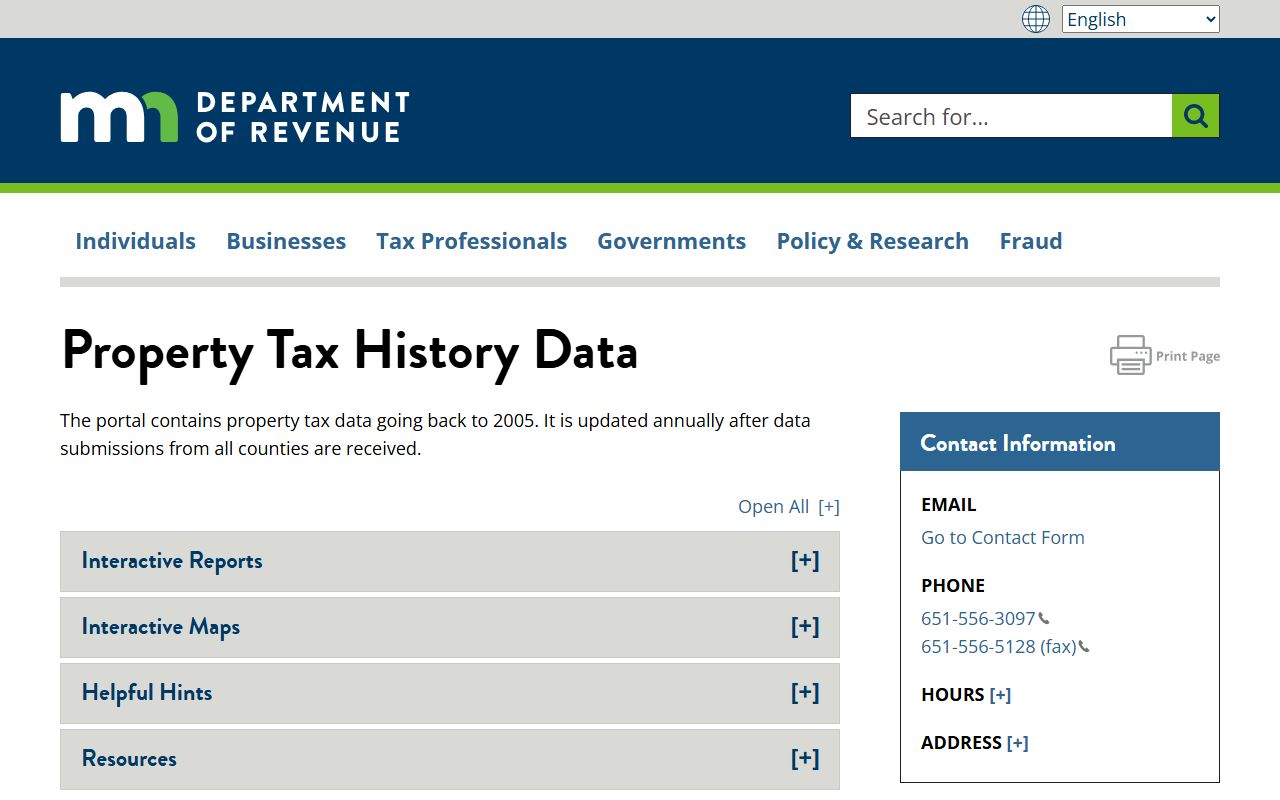
Historical property tax data for Sherburne County is available at revenue.state.mn.us/property-tax-history-data, showing levy and value trends by year.
Sherburne County Land Records and Recorder
The Sherburne County Recorder keeps deed records and other land documents that tie directly to property ownership and tax assessment. When a property changes hands, the deed is recorded here and the sale informs the assessor's valuation of nearby parcels. The deed tax paid at recording is governed by MN Statutes Chapter 272. The recorder page at co.sherburne.mn.us/departments/recorder explains how to file documents and how to search existing land records.
For title research, buyers and lenders use the recorder's office to trace ownership history and check for liens or encumbrances. The Beacon system at beacon.schneidercorp.com combines parcel data with ownership information in one search, making it a useful first stop before going deeper into recorder records.
Appealing a Sherburne County Property Tax Assessment
You have the right to challenge your assessed value in Sherburne County. Start with the assessor's office. A lot of disputes are handled informally at this stage. If that does not work, attend the Local Board of Appeal and Equalization in the spring. This board meets under Chapter 274 and reviews evidence you bring, such as sales comparables or an independent appraisal. If you are still not satisfied, the next step is the County Board of Appeal and Equalization.
After the county boards, you can file a petition with the Minnesota Tax Court under Chapter 278. The Tax Court handles cases from all Minnesota counties including Sherburne. You can reach them at (651) 539-3260. The April 30 deadline to file with the Tax Court is firm. If you miss it, you cannot appeal until the next year's assessment cycle.
Nearby Counties
These counties border Sherburne County. Each handles property tax records through its own assessor and auditor-treasurer offices.