
Find Cook County Property Tax Records
Cook County property tax records are maintained by the county assessor and auditor-treasurer in Grand Marais, Minnesota. You can search parcel data, view assessed values, and check payment history through the Beacon online portal or by contacting county offices directly. This page covers how to access Cook County property tax records, how the assessment and billing process works, what payment options are available, and how to appeal an assessment you believe is inaccurate.
Cook County Overview
How Cook County Property Taxes Work
Property taxes in Cook County follow Minnesota's statewide framework. The county assessor values each parcel as of January 2 each year under Minnesota Statutes Chapter 273. Cook County is Minnesota's northeastern corner county along Lake Superior and the Canadian border, and it has a distinctive mix of property types. Residential homes in Grand Marais, cabins and seasonal retreats along the North Shore, resorts near the Boundary Waters, and large tracts of forested land all fall under the assessor's valuation responsibilities. Much of the county's land is federal or state-owned, which limits the taxable base considerably.
The auditor-treasurer handles billing after values are determined. Tax statements go out by March 31 each year. Taxes are split into two halves. The first half is due May 15 and the second half is due October 15 under MN Statutes Chapter 276. Late payments trigger interest under Chapter 279. Long-term delinquent parcels can enter the forfeiture process under Chapter 282.
Cook County and its local taxing districts hold Truth in Taxation hearings each fall under Chapter 275. Hearings take place before December 31, and residents can attend to review and comment on proposed levy changes.
Note: Seasonal and recreational property makes up a significant portion of Cook County's tax base. Non-resident owners should pay close attention to tax statement mailings and due dates each year.
Search Cook County Property Tax Records Online
The main tool for searching Cook County property tax records online is the Beacon system by Schneider Geospatial. Beacon lets you search by owner name, address, or parcel ID number and view assessed values, tax amounts, land and building data, and ownership history. The portal is free and available at beacon.schneidercorp.com. This is particularly useful for non-resident property owners who want to check on their Cook County parcel without making a phone call.
The Cook County website at co.cook.mn.us also links to assessor and auditor-treasurer resources. The assessor's page at co.cook.mn.us/departments/assessor covers homestead applications, property classifications, and appeal information. The auditor-treasurer page at co.cook.mn.us/departments/auditor-treasurer has payment options and tax statement details. Both offices are at 411 W 2nd Street in Grand Marais. The assessor's phone is (218) 387-3650 and the auditor-treasurer is at (218) 387-3610.
For broader statewide data, the Minnesota DOR publishes county-level property tax statistics at revenue.state.mn.us and MnGeo provides parcel mapping at mngeo.state.mn.us.
The screenshot below is from the Cook County official website, which links to assessor, auditor-treasurer, and recorder resources for Cook County property tax records.

The county site at co.cook.mn.us connects you to the departments that handle Cook County property tax records and parcel information.
Cook County Assessor Office
The Cook County Assessor values all real and personal property in the county each year. The assessor's office sets estimated market values as of January 2 under MN Statutes Chapter 273. Cook County presents some unique assessment challenges. North Shore lakeshore and cabin properties can have highly variable values depending on lake access, lot size, and proximity to Grand Marais. Resort and commercial lodging properties near the Boundary Waters Canoe Area add another layer of complexity. The assessor handles all of these property types along with the year-round residential market in Grand Marais.
If you think your property has been assessed too high, start by calling the assessor at (218) 387-3650. Ask what comparable sales were used and how the value was determined. If the conversation doesn't resolve it, you can appear before the Local Board of Appeal and Equalization in spring under Chapter 274. For seasonal cabin owners, the spring hearing window may coincide with times you are not in the area, so plan ahead if you want to attend in person.
| Office | Cook County Assessor |
|---|---|
| Address | 411 W 2nd Street, Grand Marais, MN 55604 |
| Phone | (218) 387-3650 |
| Website | co.cook.mn.us/departments/assessor |
Paying Cook County Property Taxes
The Cook County Auditor-Treasurer handles all property tax billing and collection. Tax statements are mailed by March 31 each year. Taxes are due in two halves. First half is due May 15 and the second half is due October 15. Homestead properties with total bills under $100 can pay in full by May 15. The auditor-treasurer phone is (218) 387-3610.
You can pay in person at 411 W 2nd Street in Grand Marais. Check the county website at co.cook.mn.us/departments/auditor-treasurer for current online and mail payment options. Many non-resident cabin and property owners in Cook County pay by mail or online since they are not in the county year-round. It is a good idea to confirm payment methods before each due date to avoid any surprises. Always include your parcel ID with any payment to ensure it goes to the right account.
Unpaid taxes trigger interest and penalties under Chapter 279. Multi-year delinquency can result in tax forfeiture under Chapter 282. Cook County manages a list of forfeited land parcels under that chapter as properties become available for public sale.
Homestead and Seasonal Property in Cook County
Homestead classification lowers the class rate on your primary home. To qualify in Cook County, you must own and occupy the property as your main home by December 1 and apply through the assessor's office by December 31. Under Chapter 273, homestead property carries a lower rate than non-homestead residential property. You need your Social Security number or ITIN to apply.
Cook County has a large number of seasonal and vacation properties along the North Shore. Cabins, lake homes, and resort units that are not your primary residence do not qualify for homestead. These properties are typically classified as seasonal recreational residential (SRR), which has its own class rate. If you own both a year-round home and a Cook County cabin, only the home where you live full-time can hold homestead status. If you are unsure how your cabin is classified, call the assessor at (218) 387-3650 to confirm.
The Minnesota Property Tax Refund through Form M1PR is available to qualifying property owners and renters through the Minnesota Department of Revenue at revenue.state.mn.us. This state-level credit is based on income and property tax paid and is separate from homestead classification.
Cook County Land Records and Recorder
The Cook County Recorder records deeds, mortgages, and other documents affecting real property in the county. Each time a property changes ownership, the deed is filed here under MN Statutes Chapter 272. Sale data from recorded deeds informs the assessor's market value analysis. Because Cook County has a relatively thin sales market compared to urban areas, recorded sales data is especially important for setting accurate values in this remote county. The recorder is at co.cook.mn.us/departments/recorder.
The Beacon portal pulls current ownership data alongside assessed values, so a single search shows both the tax record and ownership chain. This is useful for buyers, researchers, and anyone checking on a specific Cook County parcel before contacting the county. MnGeo's statewide parcel dataset at mngeo.state.mn.us also includes Cook County parcel boundaries.
The screenshot below is from the Minnesota DOR's property tax history data page, which includes historical levy and value figures for Cook County.
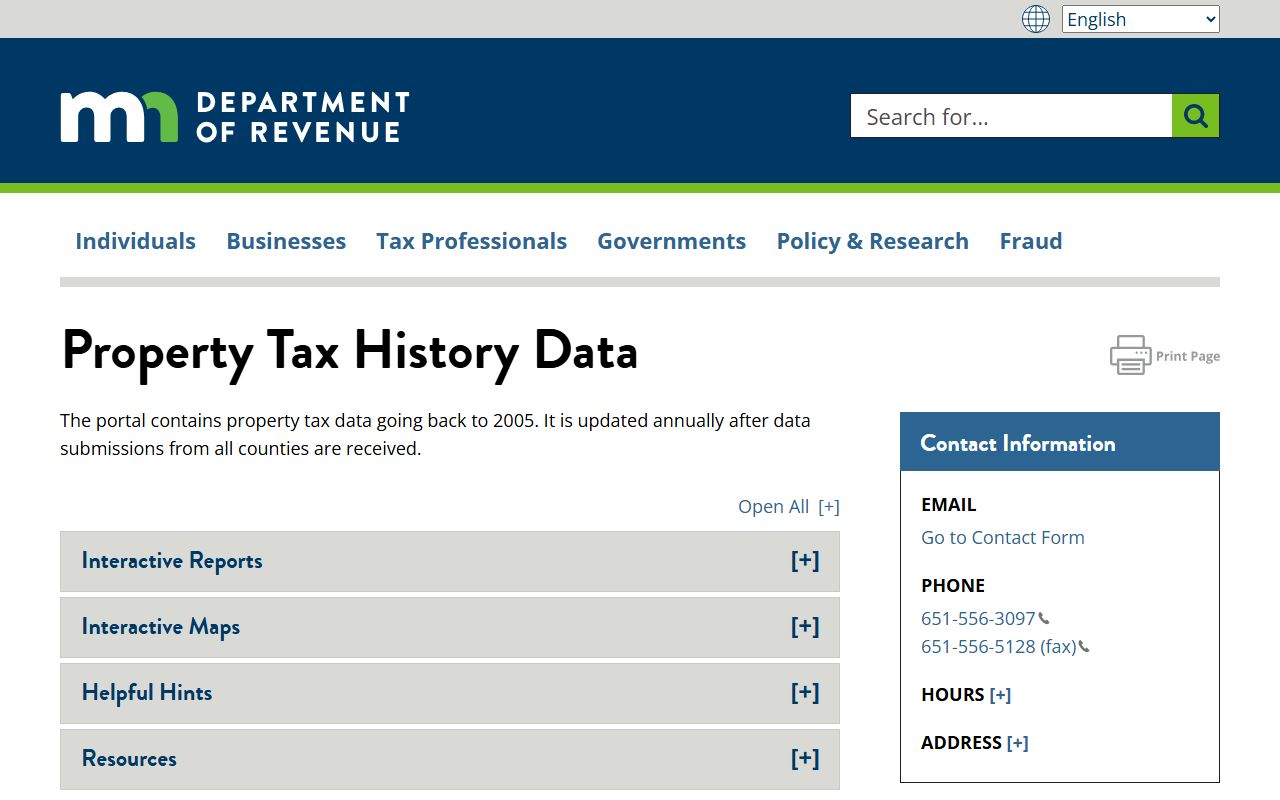
The DOR property tax history page at revenue.state.mn.us/property-tax-history-data provides historical assessment and levy data for Cook County and all other Minnesota counties.
Appealing Your Cook County Property Assessment
If you believe the Cook County assessor overvalued your property, start by calling the assessor at (218) 387-3650. Ask how the value was set and what market data was used. Many appeals resolve at this stage without going further. If you are still not satisfied, you can appear before the Local Board of Appeal and Equalization in spring under Chapter 274. Bring comparable sales, an appraisal, or other documentation that supports a lower value.
If the Local Board does not change the value, the next step is the County Board of Appeal and Equalization. Beyond that, you can file a petition with the Minnesota Tax Court at (651) 539-3260 or through mn.gov/tax-court. Tax Court petitions must be filed by April 30 of the payable year under Chapter 278. Non-resident cabin owners should mark this deadline in advance to avoid losing their appeal rights.
Nearby Counties
These counties border Cook County. Each has its own assessor and auditor-treasurer handling property tax records locally.