
St. Louis County Property Tax Records
St. Louis County property tax records are managed by the county's Property and Taxation Services department with offices in Duluth, Hibbing, and Virginia, Minnesota. You can search parcel data, look up assessed values, and find tax statement information through the county's online property search tool or by contacting one of the offices directly. This page covers how property taxes work in Minnesota's largest county by area, where to find your records, and how to appeal if your assessment looks wrong.
St. Louis County Overview
How St. Louis County Property Taxes Work
St. Louis County is the largest county in Minnesota by land area, covering a wide range of property types from urban parcels in Duluth to forested land, iron range properties, and rural homes in the northern reaches of the county. The assessor values all taxable property as of January 2 each year under Minnesota Statutes Chapter 273. That value drives the tax bill issued the following year. The diversity of land types in St. Louis County means assessment work here is more complex than in most Minnesota counties.
The county's Property and Taxation department handles billing and collection. Tax statements go out by March 31. St. Louis County taxes are split into two installments. First half is due May 15. Second half is due October 15. If you miss a payment, interest starts under MN Statutes Chapter 279. Properties with long-term unpaid taxes can enter forfeiture under Chapter 282. St. Louis County manages a significant amount of tax-forfeited land given the size of the county and the range of ownership situations across it.
Each fall, St. Louis County and its local taxing districts set levy amounts through Truth in Taxation under Chapter 275. School districts, townships, cities, and special taxing districts all factor into the rate shown on your statement.
Note: St. Louis County maintains administrative offices in three cities: Duluth, Hibbing, and Virginia. Which office handles your property depends on its location within the county.
Search St. Louis County Property Tax Records Online
The St. Louis County website provides a dedicated property search tool and tax information page. You can start your search at stlouiscountymn.gov/land-property/Property-Search. This tool lets you look up parcels by address, owner name, or parcel ID. You can find assessed values, tax amounts, ownership information, and links to tax statements. The county's property and tax information page is at stlouiscountymn.gov/land-property/Property-Taxes.
GIS mapping tools and parcel boundary data are available through the county's maps section at stlouiscountymn.gov/land-property/Maps. For phone contact on property tax and assessment questions, reach the Property and Taxation office at (218) 726-2553 and the Assessor at (218) 725-5020. The main mailing address is 1001 E Mesabi Avenue, Hibbing, MN 55746.
The Minnesota Department of Revenue publishes statewide property tax data at revenue.state.mn.us, including St. Louis County levy totals and assessment figures. This is useful for comparison and research purposes.
The Minnesota DOR site covers state property tax forms, refund programs, and county-level data for St. Louis County. The image below is from that site.
The DOR site at revenue.state.mn.us is the home for state property tax forms, refunds, and data that covers St. Louis County along with all other Minnesota counties.
St. Louis County Assessor Office
The St. Louis County Assessor values all real and personal property across the county as of January 2 each year. The scale of this work is substantial: the county covers thousands of square miles and includes parcels ranging from downtown Duluth commercial buildings to remote iron range properties and lakeshore cabins. Under Chapter 273, all property must be valued at its fair market value unless a special classification applies. The assessor's page at stlouiscountymn.gov/land-property/Assessor covers homestead applications, classification details, and how to request a review of your value.
If you believe your value is too high, start with the assessor's office at (218) 725-5020. Many concerns can be addressed without a formal appeal. If not, you can attend the Local Board of Appeal and Equalization in spring under Chapter 274. The size of St. Louis County means these board hearings occur in different locations depending on your property's location. Check with the assessor's office to find out where your local board meets.
| Office | St. Louis County Assessor |
|---|---|
| Address | 1001 E Mesabi Avenue, Hibbing, MN 55746 |
| Phone | (218) 725-5020 |
| Website | stlouiscountymn.gov/land-property/Assessor |
Paying St. Louis County Property Taxes
St. Louis County mails tax statements by March 31. First half is due May 15. Second half is due October 15. The property and taxation department at stlouiscountymn.gov/land-property/Property-Taxes describes current payment options. You can pay in person at the Duluth, Hibbing, or Virginia offices depending on your location. For phone questions, call (218) 726-2553. Have your parcel ID from your statement ready to speed things up.
If taxes go unpaid, interest and penalties accrue under Chapter 279. Eventually, unpaid taxes can lead to tax forfeiture under Chapter 282. St. Louis County handles a significant volume of tax-forfeited land sales, which are listed on the county website. Properties that come back into private ownership through these sales pay regular taxes going forward.
The Minnesota Property Tax Refund (Form M1PR) is a state-level credit for homeowners and renters with limited income. You file it through the Minnesota Department of Revenue. Details and the form are at revenue.state.mn.us.
The interactive property tax data tool from the Minnesota DOR allows comparisons across all Minnesota counties including St. Louis. The screenshot below shows that tool.
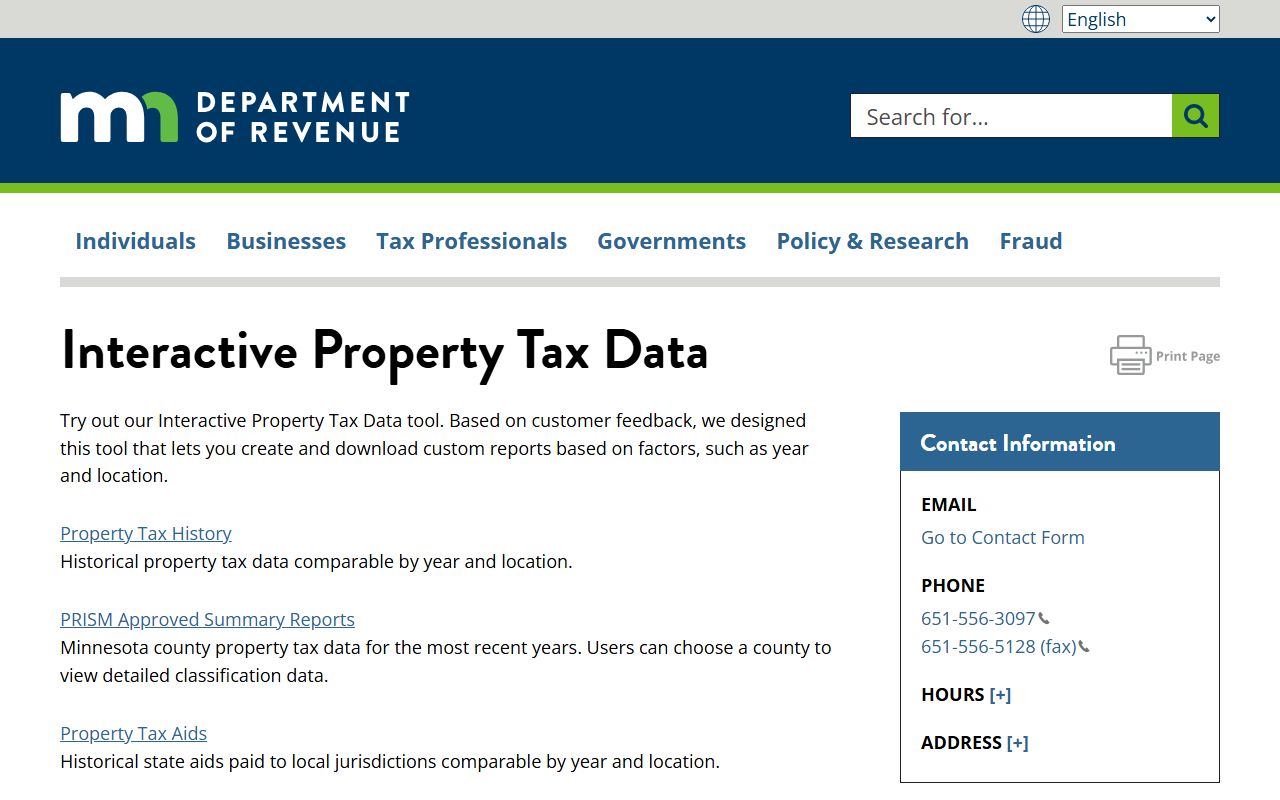
The interactive data tool at revenue.state.mn.us/interactive-property-tax-data lets you view levy rates, assessed values, and trends for St. Louis County compared to other Minnesota counties.
Homestead Classification in St. Louis County
Homestead status lowers the class rate on your primary residence in St. Louis County, which reduces your tax bill. To get it, you must own and occupy the property as your main home by December 1 and apply through the St. Louis County Assessor by December 31. You need to supply a Social Security number or ITIN. Under Chapter 273, homestead property carries a lower class rate than non-homestead residential property. In a county with a range of income levels like St. Louis County, homestead status can make a real difference on the annual bill.
Many properties in St. Louis County are seasonal cabins, lakeshore retreats, or hunting land. These do not qualify for homestead. Only your primary year-round residence gets the homestead class rate. If you own both a cabin and a home in St. Louis County, only your main home qualifies. Contact the assessor to confirm your classification is correct.
Note: Duluth residents in St. Louis County may have additional local programs available through the City of Duluth that interact with state-level property tax relief.
Cities in St. Louis County
St. Louis County is home to several communities. The county seat is Duluth, which is the largest city in the county and one of the larger cities in Minnesota. Duluth has its own city page with more specific property tax resources for residents in that city.
Visit the Duluth property tax records page for details specific to that city, including courthouse locations, local contacts, and city-level resources.
St. Louis County Land Records and Recorder
The St. Louis County Recorder keeps deed records, mortgages, and other land documents that tie to property tax assessments throughout the county. When a property sells, the deed is recorded here and the sale price enters the assessor's market data. Deed tax at recording follows MN Statutes Chapter 272. The recorder page at stlouiscountymn.gov/land-property/Recorder explains how to file and search land records in the county.
Given the size of St. Louis County and its long history as a mining and timber region, the land records here go back many decades and cover a wide variety of ownership and legal situations. Researchers, title companies, and buyers use these records to trace chains of title and verify clear ownership. The county's property search at stlouiscountymn.gov provides a useful starting point before going into the detailed recorder records.
Appealing a St. Louis County Property Assessment
If you think your St. Louis County property is overvalued, you have the right to appeal. Start by contacting the assessor at (218) 725-5020. Many valuation questions can be resolved at this stage. If not, attend the Local Board of Appeal and Equalization in spring under Chapter 274. Because St. Louis County spans such a large area, the local board meets in different locations. Ask the assessor's office where your board meets and when.
After the local and county boards, you can petition the Minnesota Tax Court under Chapter 278. The Tax Court handles appeals from all 87 Minnesota counties. You can reach them at (651) 539-3260. The deadline to file is April 30 of the year your taxes are payable. File early, since processing can take time and the deadline is firm.
Nearby Counties
These counties border St. Louis County. Each maintains its own property tax records and offices.